Overview
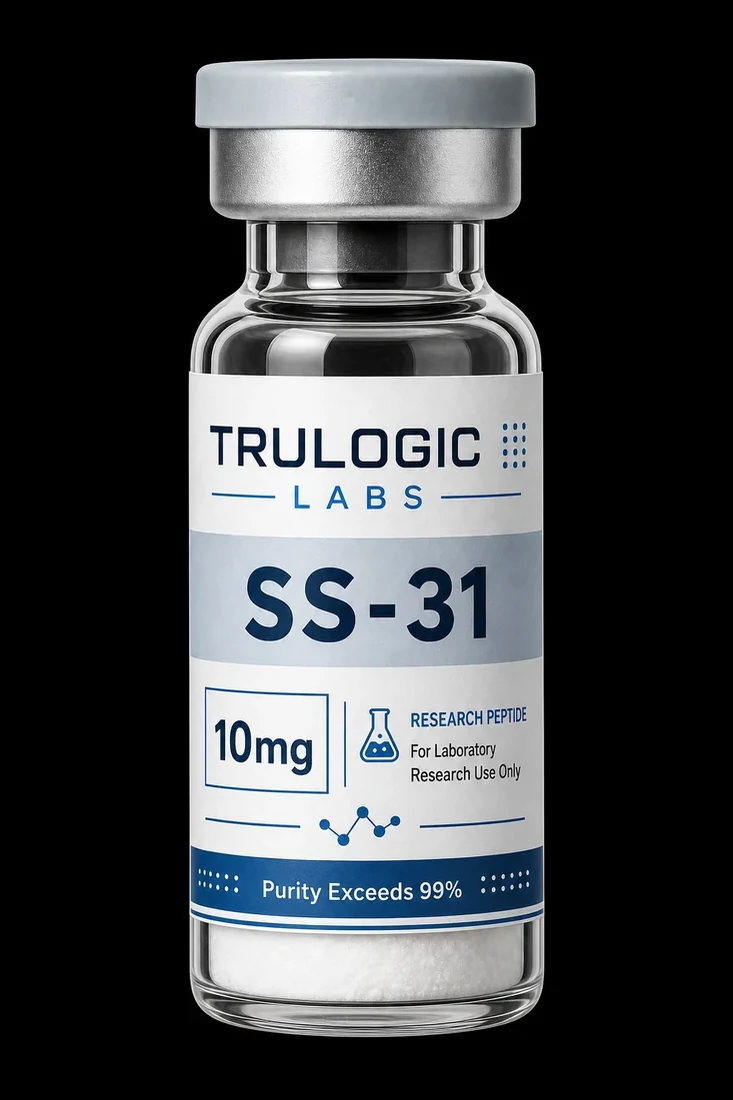
SS-31, also known by the investigational drug name elamipretide, belongs to a class of aromatic-cationic ‘Szeto-Schiller’ peptides designed to concentrate in mitochondria independently of membrane potential. Research has focused on its interaction with cardiolipin, a phospholipid of the inner mitochondrial membrane critical to the structure and function of the electron transport chain. Unlike many research peptides, SS-31 has advanced into formal clinical development for select mitochondrial and cardiac conditions.
Mechanism of action
SS-31 selectively binds cardiolipin in the inner mitochondrial membrane. By associating with cardiolipin, it is proposed to stabilize cristae architecture, support electron transport chain efficiency, and reduce excessive reactive oxygen species production during stress. This is thought to preserve ATP synthesis and protect mitochondrial integrity under conditions of injury or aging. The peptide does not appear to act as a simple free-radical scavenger but rather to modulate membrane organization.
Research findings
Laboratory studies report binding to cardiolipin and stabilization of inner mitochondrial membrane structure.,Animal models of ischemia-reperfusion injury have reported preserved mitochondrial function with SS-31 exposure.,Aging-model research suggests associations between SS-31 and improved markers of muscle and cardiac bioenergetics.,Clinical trials have evaluated elamipretide in specific conditions such as primary mitochondrial myopathy, with mixed and condition-dependent outcomes.,Efficacy across broader aging applications in humans remains unproven.
Research context
SS-31/elamipretide has been characterized in clinical pharmacokinetic studies with a reported half-life on the order of a few hours, and study durations in trials have ranged from short exposures to multi-week protocols depending on the condition. Research endpoints have centered on mitochondrial function assays, exercise/functional measures, and disease-specific biomarkers rather than a uniform protocol. This is a research reference only. Not approved for human use outside regulated settings; consult the primary literature.
Handling & storage
Lyophilized powder is generally stored frozen and protected from light and moisture under controlled laboratory conditions. Reconstituted solutions are typically refrigerated and handled per standard peptide laboratory practice, avoiding repeated freeze-thaw cycles.
Reported safety signals
In clinical study settings, tolerability has generally been reported as acceptable, with local administration-site reactions among the more commonly noted effects. Full safety characterization depends on the specific condition and trial population.
Studied alongside
SS-31 is discussed in mitochondrial and longevity research alongside NAD+ biology and other energy-metabolism-focused compounds; controlled combination data in humans are limited.
At a glance
Research strengths
- Well-defined, mitochondria-selective mechanism centered on cardiolipin
- Has advanced into formal clinical trials, unlike many research peptides
- Substantial preclinical literature on bioenergetics and tissue protection
- Defined pharmacokinetic profile from clinical studies
Limitations & cautions
- Broad anti-aging efficacy in humans is unproven
- Clinical trial outcomes have been mixed and condition-specific
- Not approved for general use; investigational status
- Mechanistic benefits in models do not guarantee functional human outcomes