Overview
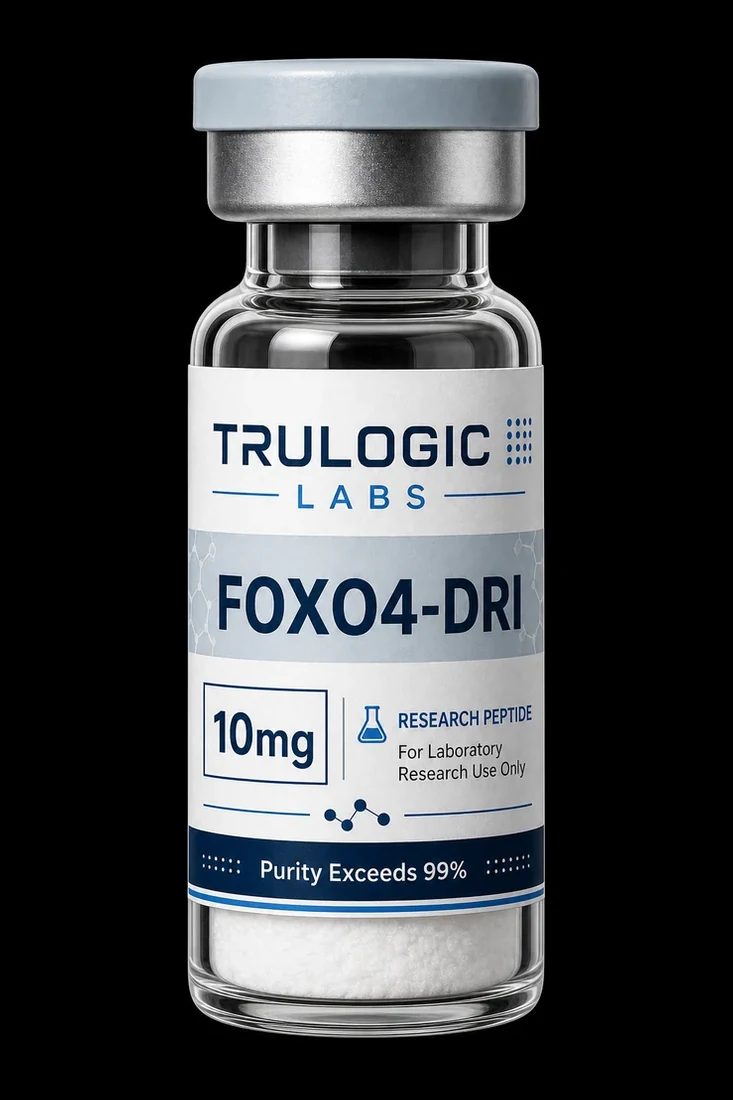
FOXO4-DRI is an engineered peptide derived from the region of the FOXO4 transcription factor that interacts with p53. It is built using a D-retro-inverso (DRI) design, in which D-amino acids are assembled in reverse sequence to mimic the spatial arrangement of the parent peptide while increasing resistance to enzymatic degradation. It emerged from research into cellular senescence and senolytics, the concept of selectively clearing senescent cells that accumulate with age.
Mechanism of action
Senescent cells are reported to depend on a FOXO4-p53 interaction that sequesters p53 in the nucleus and helps them resist apoptosis. FOXO4-DRI is designed to competitively disrupt this interaction, allowing p53 to relocate and trigger programmed cell death preferentially in senescent cells while sparing healthy cells. This proposed selectivity is the basis for its classification as a candidate senolytic in the research literature.
Research findings
A foundational rodent study reported selective induction of apoptosis in senescent cells with FOXO4-DRI exposure.,That research described improvements in some markers of fitness, fur density, and renal function in aged or chemotherapy-treated mice.,The peptide is characterized in the literature as a proof-of-concept senolytic targeting the FOXO4-p53 axis.,Independent replication and broader characterization remain limited.,No established human clinical efficacy or safety data exist.
Research context
FOXO4-DRI is studied almost entirely in preclinical models, with the D-retro-inverso architecture intended to extend stability against proteases; precise in vivo half-life and pharmacokinetics are not well characterized. Reported study designs have used intermittent exposure schedules in animals, reflecting the senolytic ‘hit-and-clear’ concept rather than continuous dosing. This is a research reference only. Not approved for human use outside regulated settings; consult the primary literature.
Handling & storage
Lyophilized powder is generally stored frozen, protected from light and moisture, under controlled laboratory conditions. Reconstituted material is typically kept cold and handled per standard peptide laboratory practice, avoiding repeated freeze-thaw cycles.
Reported safety signals
The human side-effect profile is not characterized. Because the mechanism involves p53-mediated apoptosis, off-target or systemic effects are a recognized theoretical concern in the research literature and a focus of ongoing study.
Studied alongside
FOXO4-DRI is discussed within the broader senolytic and longevity research landscape alongside other aging-focused compounds such as Epithalon and NAD+ biology; controlled combination data are absent.
At a glance
Research strengths
- Clearly defined molecular target (FOXO4-p53 interaction)
- D-retro-inverso design intended to improve proteolytic stability
- Proof-of-concept preclinical results in a notable published study
- Represents a distinct senolytic mechanism within longevity research
Limitations & cautions
- Evidence is limited to early preclinical work with sparse replication
- No human safety or efficacy data
- p53/apoptosis-based mechanism raises theoretical off-target concerns
- Pharmacokinetics and exact molar mass are not well characterized