Overview
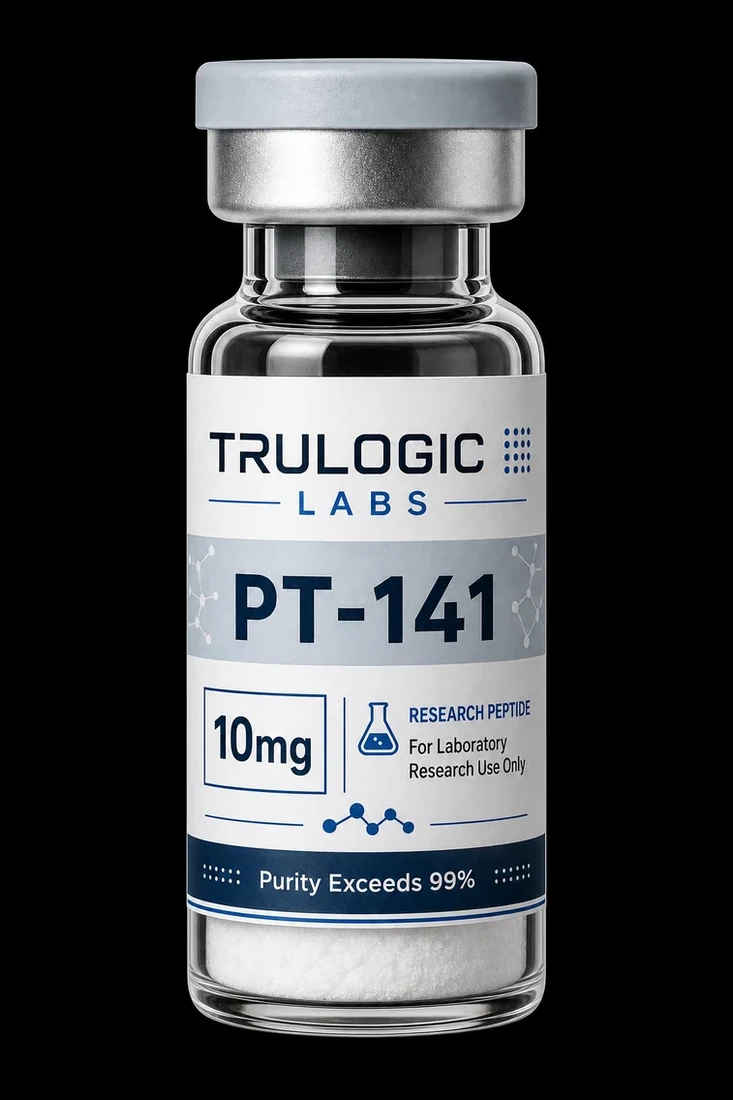
PT-141, known generically as bremelanotide, is a cyclic seven-amino-acid peptide derived from the structure of melanotan II. It was developed specifically to retain the sexual-response effects associated with melanocortin agonism while reducing the pronounced pigmentation effects of its parent compound.
Bremelanotide is notable among the peptides in this reference for having achieved FDA approval (as Vyleesi) for hypoactive sexual desire disorder in premenopausal women, giving it a more developed clinical profile than most research peptides.
Mechanism of action
Research suggests PT-141 acts as an agonist at melanocortin receptors, with particular relevance to the MC4 receptor in the central nervous system. By activating these pathways in the hypothalamus, it is thought to influence neural circuits associated with sexual arousal.
This central mechanism distinguishes it from vascular agents that act on peripheral blood flow. The effect is described as centrally mediated modulation of arousal signaling rather than a direct circulatory action.
Research findings
Has been studied for centrally mediated effects on sexual arousal via melanocortin pathways.,Demonstrated efficacy in clinical trials supporting FDA approval for hypoactive sexual desire disorder in premenopausal women.,Research suggests primary activity at the MC4 receptor in the central nervous system.,Studied for effects independent of peripheral vascular mechanisms.,Transient blood pressure changes have been reported in clinical studies.
Research context
PT-141 has a reported circulating half-life of roughly 2.7 hours, and its pharmacokinetics have been characterized in the controlled clinical trials supporting its approved indication. Study populations and parameters in the published literature reflect that regulated context rather than general research use. This entry summarizes findings at a high level only. This is a research reference only. Not approved for human use outside regulated settings; consult the primary literature.
Handling & storage
Lyophilized peptide is typically stored at -20 degrees Celsius for long-term laboratory storage, protected from light and moisture. After reconstitution in a laboratory context it is generally refrigerated and used within a limited window. Avoid repeated freeze-thaw cycles.
Reported safety signals
Clinical literature commonly reports nausea, flushing, and headache as the most frequent effects, along with transient increases in blood pressure and occasional injection-site reactions. Pigmentation effects are reduced relative to its parent compound. Safety characterization should rely on the primary literature.
Studied alongside
In the research community PT-141 is sometimes discussed alongside other melanocortin agonists such as melanotan 2 and melanotan 1, though these share overlapping mechanisms. Combination data outside its approved single-agent use are limited.
At a glance
Research strengths
- FDA-approved (as bremelanotide) for a defined sexual-health indication.
- Centrally acting mechanism distinct from vascular agents.
- Reduced pigmentation effect compared with melanotan II.
- Well-characterized clinical pharmacokinetics.
Limitations & cautions
- Nausea and flushing are commonly reported.
- Can cause transient blood pressure elevation.
- Approved indication is narrow and population-specific.
- Onset and duration vary between individuals.