Overview
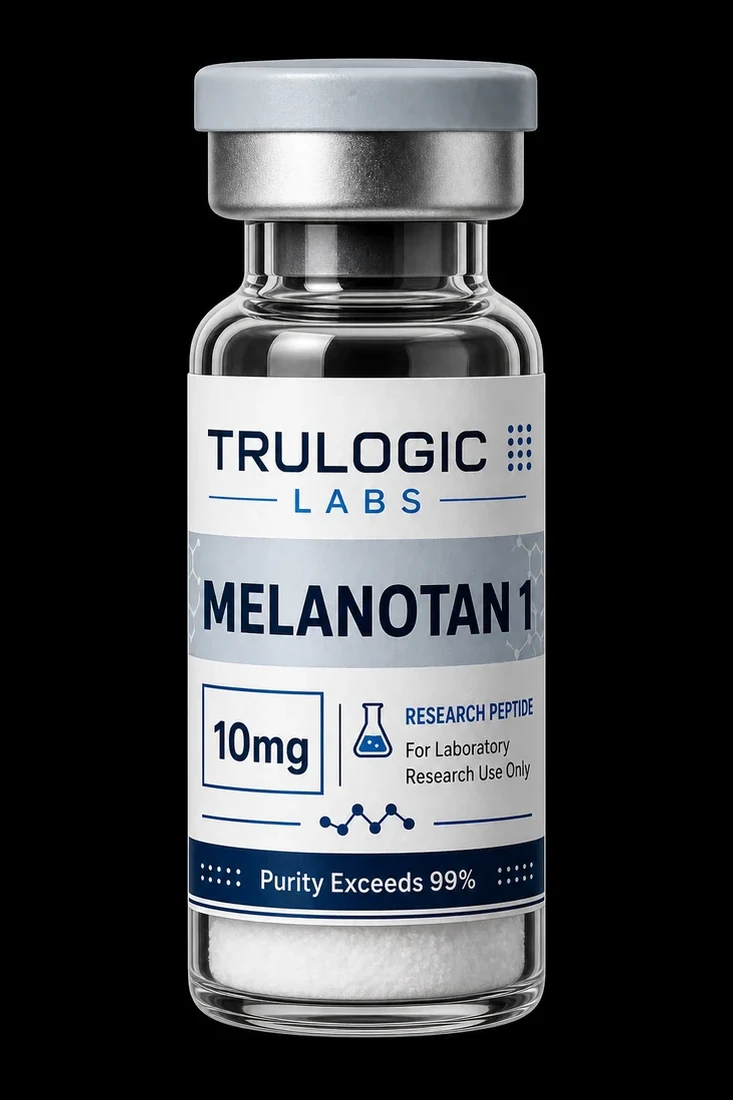
Melanotan 1, generically afamelanotide, is a 13-amino-acid linear analog of alpha-MSH. It was developed with a focus on photoprotection through increased melanin production and has the most advanced regulatory profile of the melanotan compounds.
Afamelanotide is approved in the European Union, the United States, and other regions (as Scenesse) for erythropoietic protoporphyria, a rare light-sensitivity disorder, typically delivered as a controlled-release implant in clinical settings.
Mechanism of action
Research suggests Melanotan 1 acts with relative selectivity as an agonist at the MC1 receptor on melanocytes, stimulating eumelanin production and thereby increasing skin pigmentation. This MC1-focused activity underlies its photoprotective rationale.
Because it is more selective for MC1 than the non-selective melanotan 2, its central melanocortin effects on appetite and arousal are comparatively less pronounced in the literature.
Research findings
Has been studied for MC1 receptor-driven stimulation of melanin production and photoprotection.,Approved as afamelanotide for erythropoietic protoporphyria in several regions.,Research suggests greater MC1 selectivity than melanotan 2.,Studied as a controlled-release implant in regulated clinical use.,Investigated in other photosensitivity and dermatologic research contexts.
Research context
The free peptide has a short circulating half-life of around one hour, while the approved clinical product uses a controlled-release implant that extends exposure over days. Published pharmacokinetics largely reflect that regulated depot formulation rather than research-grade powder. This entry summarizes findings at a high level only. This is a research reference only. Not approved for human use outside regulated settings; consult the primary literature.
Handling & storage
Lyophilized peptide is typically stored at -20 degrees Celsius for long-term laboratory storage and protected from light and moisture. After reconstitution in a laboratory context it is generally refrigerated and used within a limited window. Avoid repeated freeze-thaw cycles.
Reported safety signals
Reported effects in clinical literature include darkening of skin and existing pigmented lesions, nausea, and headache, generally fewer central effects than melanotan 2. Safety characterization should rely on the primary literature.
Studied alongside
It is discussed in the research community alongside the related melanocortin agonists melanotan 2 and PT-141, which share the broader melanocortin family. Combination data are not well characterized.
At a glance
Research strengths
- Approved (as afamelanotide) for a defined rare-disease indication.
- More MC1-selective than melanotan 2.
- Well-characterized clinical depot formulation.
- Strong photoprotective pigmentation rationale.
Limitations & cautions
- Free peptide has a very short half-life.
- Pigmentation of moles and lesions is commonly reported.
- Approved indication is narrow and rare.
- Research-grade pharmacokinetics differ from the clinical implant.