Overview
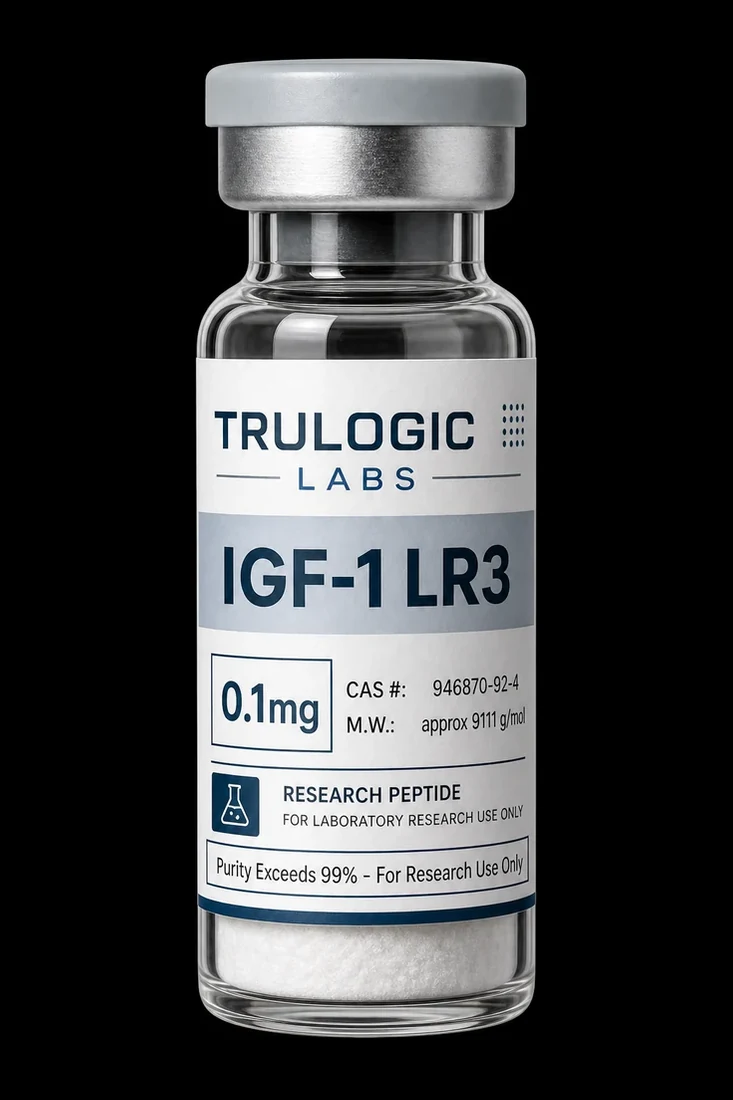
IGF-1 LR3 is a recombinant analog of human insulin-like growth factor-1 modified in two ways: an arginine substituted for the glutamic acid at position 3, and a 13-amino-acid extension added to the N-terminus. These changes substantially reduce its affinity for IGF-binding proteins (IGFBPs), which normally sequester circulating IGF-1, and this has been studied as a basis for its prolonged activity. It is most commonly encountered as a laboratory reagent for studying growth-factor signaling and cell proliferation.
Mechanism of action
IGF-1 LR3 binds and activates the type 1 IGF receptor (IGF-1R), a receptor tyrosine kinase, initiating downstream PI3K/Akt and MAPK signaling cascades associated with cell growth, proliferation, and survival. Because its modifications lower IGFBP binding, a greater fraction remains free and receptor-available compared with native IGF-1, which is studied as the reason for its enhanced and prolonged signaling in research settings. It can also interact, with lower affinity, with the insulin receptor.
Research findings
Research has characterized reduced binding to IGF-binding proteins relative to native IGF-1, leaving more peptide free to engage IGF-1R.,Cell-culture studies report enhanced potency and prolonged signaling activity compared with unmodified IGF-1.,It is widely employed as a supplement in laboratory cell-culture media to support proliferation.,Activation of PI3K/Akt and MAPK pathways downstream of IGF-1R has been documented in research models.,Cross-reactivity with the insulin receptor, and resulting effects on glucose handling, is noted in the literature as an area of attention.
Research context
In the research literature, IGF-1 LR3 is characterized by markedly extended activity relative to native IGF-1, attributed to its reduced affinity for binding proteins rather than to any single fixed half-life value; reported durations vary by model system. Study exposures and concentrations differ widely across cell-culture and animal investigations, and pharmacokinetic behavior is model-dependent. High-level descriptors such as relative potency and signaling duration are discussed at the level of general findings. This is a research reference only. Not approved for human use outside regulated settings; consult the primary literature.
Handling & storage
Lyophilized peptide is typically stored frozen and protected from light and moisture in a controlled laboratory setting; reconstituted solutions are generally kept refrigerated for short-term use or frozen in aliquots to limit freeze-thaw cycles. Handle under standard aseptic laboratory practice, label for research use only, and dispose of per institutional protocols.
Reported safety signals
Because it activates IGF-1R potently and can cross-react with the insulin receptor, research notes the potential for effects on blood glucose (hypoglycemia) and concerns related to sustained proliferative signaling. Safety in humans is not well characterized, as it is used predominantly as a research reagent.
Studied alongside
In research discussion it is positioned downstream of the growth hormone axis and is therefore grouped conceptually with growth hormone (HGH 191AA) and with GH-axis stimulators such as GHRH analogs (tesamorelin, CJC-1295) and secretagogues (ipamorelin), which raise endogenous IGF-1.
At a glance
Research strengths
- Reduced IGFBP binding yields prolonged, potent IGF-1R signaling
- Well-established as a laboratory cell-culture reagent
- Mechanism is comparatively well-characterized at the receptor level
- Useful research tool for studying growth-factor pathways
Limitations & cautions
- Potential to affect blood glucose via insulin-receptor cross-reactivity
- Human safety profile not well characterized
- Sustained proliferative signaling raises research safety considerations
- Sensitive peptide requiring careful cold-chain handling