Overview
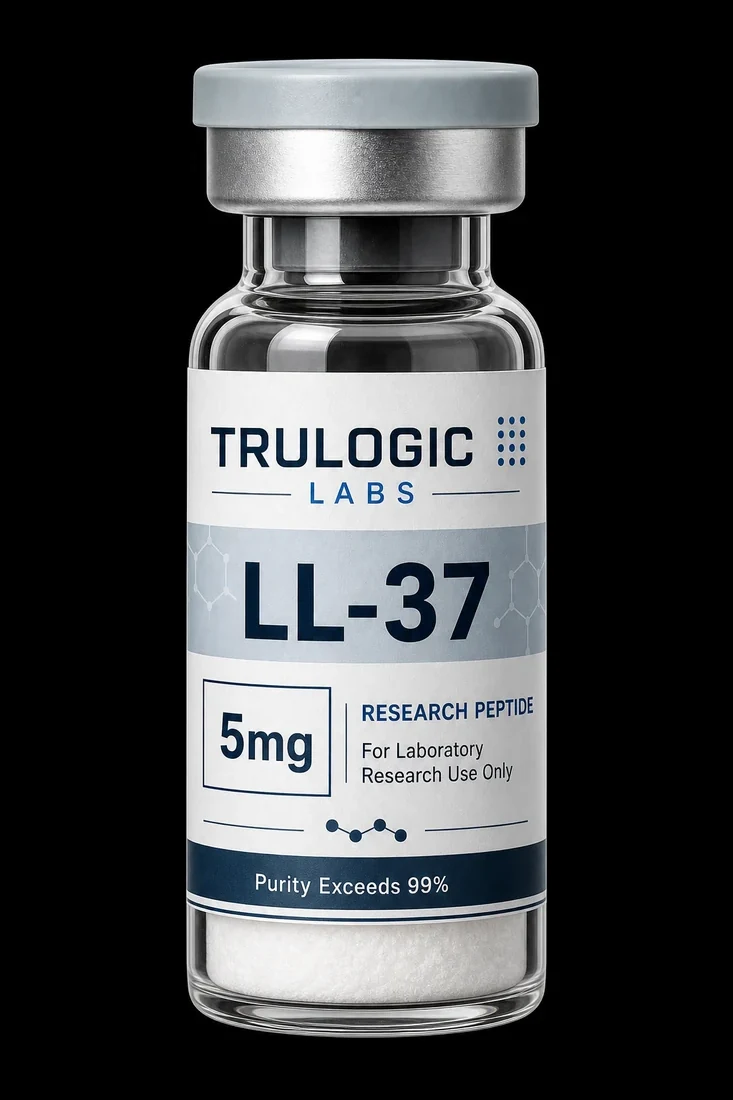
LL-37 is a 37-amino-acid cationic peptide and the sole member of the cathelicidin family in humans, released from the C-terminal portion of the hCAP18 precursor. It is an important component of innate immunity, expressed by epithelial cells and immune cells. LL-37 is extensively studied for antimicrobial and immunomodulatory roles, and it remains primarily a research peptide rather than an approved therapeutic.
Mechanism of action
As a cationic, amphipathic peptide, LL-37 can interact with and disrupt microbial membranes, contributing to direct antimicrobial activity against bacteria, fungi, and some viruses. Beyond this, it is studied as an immunomodulator that influences chemotaxis, cytokine signaling, wound healing, and angiogenesis. Its activity is highly context-dependent and can be modulated by local concentration, pH, and binding to other molecules.
Research findings
Demonstrates broad-spectrum antimicrobial activity against bacteria, fungi, and some viruses in laboratory studies.,Studied as an immunomodulator affecting chemotaxis and cytokine responses.,Research describes roles in wound healing and angiogenesis.,Implicated in the biology of several inflammatory and skin conditions in the literature.,Activity is strongly context-dependent and can vary with local conditions.
Research context
LL-37 is studied across antimicrobial, immunology, and dermatology research. Its stability and apparent half-life are reported to depend strongly on the environment and on proteolytic degradation, and human pharmacokinetics are not well characterized. Reported experimental ranges vary widely by model. This is a research reference only. Not approved for human use outside regulated settings; consult the primary literature.
Handling & storage
Lyophilized powder is typically stored frozen, protected from light and moisture, in a laboratory setting. As a longer cationic peptide it can be sensitive to surfaces and degradation; reconstituted material is generally handled cold per laboratory protocol. Follow institutional handling guidance.
Reported safety signals
Human safety as an exogenous agent is not well characterized. The literature notes that LL-37 can have both protective and pro-inflammatory effects depending on context, which is relevant to any research interpretation.
Studied alongside
In research discussion LL-37 is sometimes examined alongside KPV in host-defense and inflammation contexts, and is occasionally referenced with BPC-157 in tissue-repair research.
At a glance
Research strengths
- Endogenous human innate-immune peptide with extensive literature
- Broad-spectrum antimicrobial activity in laboratory studies
- Multifunctional roles spanning immunity and repair
- Well-defined natural sequence
Limitations & cautions
- Context-dependent effects that can be pro- or anti-inflammatory
- Not approved as a therapeutic agent
- Stability and pharmacokinetics not well characterized
- Longer peptide more susceptible to degradation