Overview
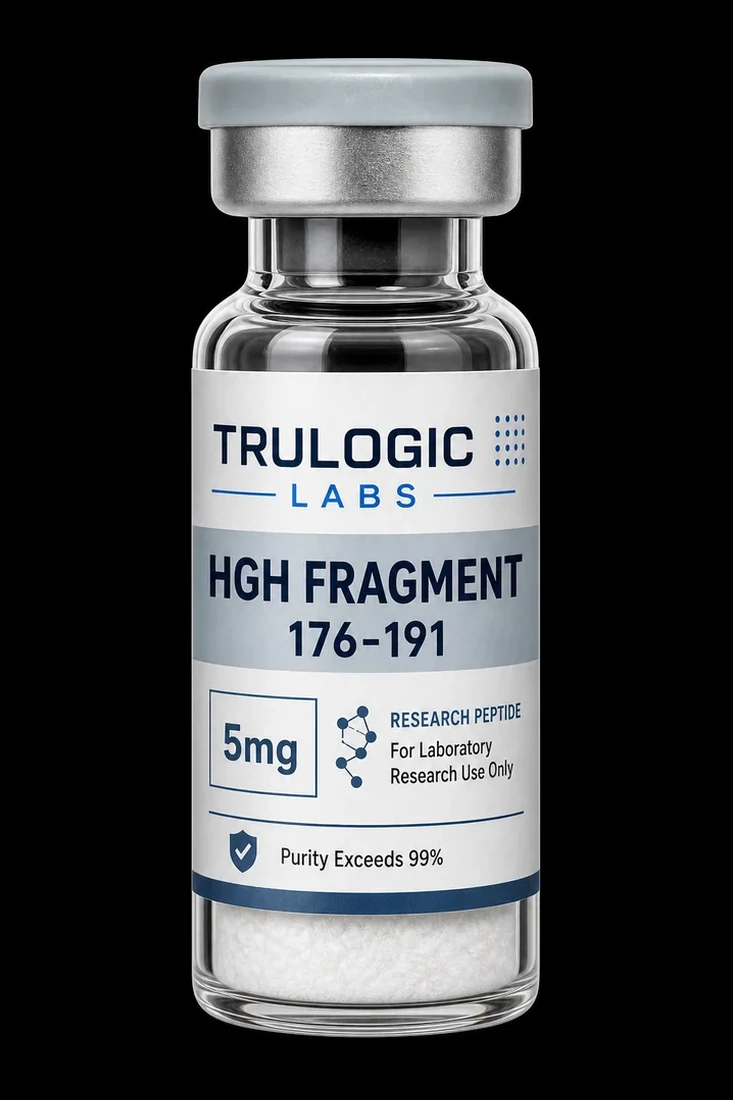
HGH Fragment 176-191 is a synthetic peptide representing a short segment near the C-terminus of the human growth hormone (hGH) molecule. Research on this fragment grew from observations that the lipolytic (fat-metabolizing) activity of growth hormone could be localized to a specific region of the protein.
The fragment is studied as a tool to examine growth hormone’s metabolic effects in isolation, since it is reported to lack much of the growth-promoting and insulin-related activity associated with the full hormone in study models.
Mechanism of action
Research describes HGH Fragment 176-191 as acting on adipose tissue to influence lipid metabolism, with study literature pointing to stimulation of lipolysis and inhibition of lipogenesis in fat cells. The exact receptor interactions are not fully characterized, and the fragment is described as working through a pathway distinct from the classical growth hormone receptor signaling responsible for IGF-1 production.
Because it is a partial sequence of growth hormone, research notes that it does not reproduce the full hormonal cascade of the intact molecule, which is the basis for interest in its comparatively selective metabolic profile.
Research findings
Corresponds to the C-terminal lipolytic region of human growth hormone.,Research suggests effects on fat-cell lipolysis and lipogenesis in models.,Reported to lack much of the growth-promoting activity of intact hGH.,Studied as a tool to isolate growth hormone’s metabolic effects.,Receptor interactions described as not fully characterized in literature.
Research context
Research literature reports a short plasma half-life for HGH Fragment 176-191, on the order of minutes, and study amounts, formulations, and metabolic readouts vary across animal and cell models. The fragment’s precise mechanism remains incompletely defined, so quantitative findings should be interpreted within their specific study contexts. This is a research reference only. Not approved for human use outside regulated settings; consult the primary literature.
Handling & storage
Typically handled in laboratory settings as a lyophilized powder stored desiccated and protected from light. Long-term storage is commonly reported at -20°C or colder, with reconstituted material refrigerated for short periods. Handle as a research chemical under standard laboratory practices.
Reported safety signals
Side effects are not well characterized in controlled human research. Literature notes possible injection-site reactions in study contexts and theoretical considerations around growth-factor-related peptides, but specific safety data remain limited.
Studied alongside
In research contexts HGH Fragment 176-191 has been examined alongside growth hormone secretagogues such as GHRP-2, GHRP-6, and ipamorelin, where metabolic and growth hormone-releasing activities are studied together.
At a glance
Research strengths
- Studied for a comparatively selective metabolic signaling profile
- Reported to isolate growth hormone's lipolytic region
- Lacks much of intact hGH's growth-promoting activity in models
- Useful as a research tool for metabolic studies
Limitations & cautions
- Mechanism and receptor interactions incompletely characterized
- Short reported half-life in pharmacokinetic studies
- Limited controlled human safety data
- Not approved for human use