Overview
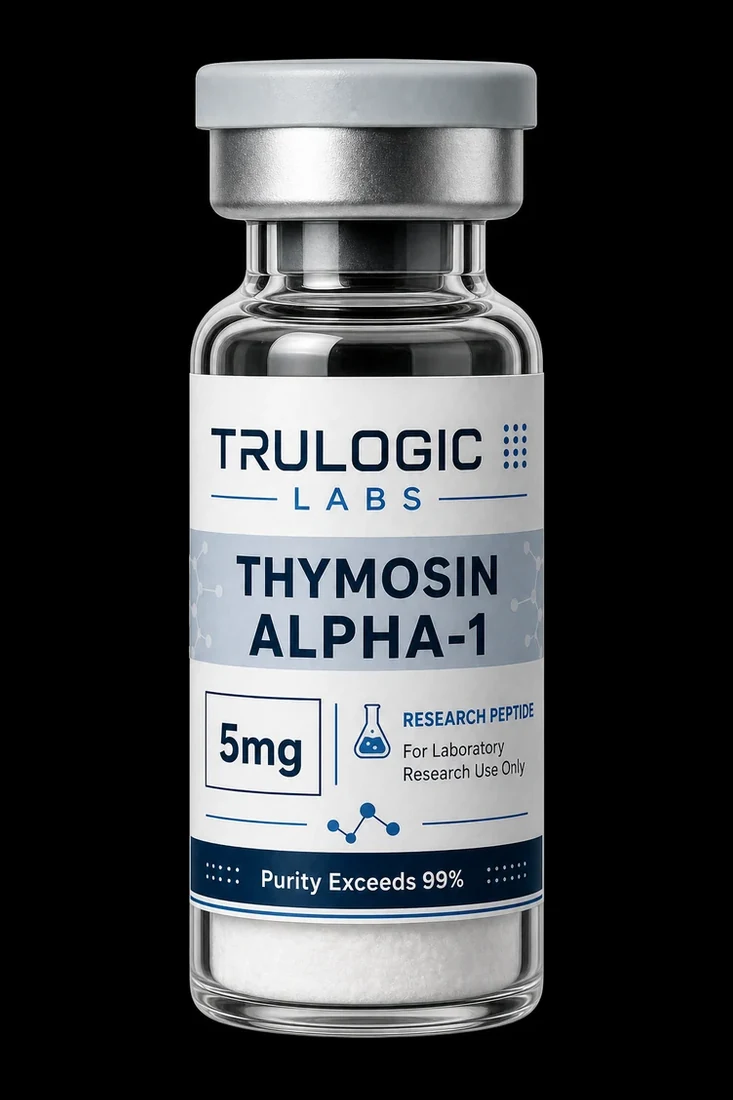
Thymosin Alpha-1 is an acetylated 28-amino-acid peptide originally isolated from thymosin fraction 5 of the thymus gland. It is one of the most extensively studied thymic peptides and has been investigated as an immunomodulator across infectious disease, oncology, and vaccine-adjuvant research contexts. Unlike compounds with a single defined receptor target, it appears to exert pleiotropic effects on multiple arms of the immune system.
The peptide has been studied for decades and is marketed under the name thymalfasin (Zadaxin) in a number of countries for indications including chronic hepatitis B and C and as an immune adjuvant, though it is not FDA-approved in the United States.
Mechanism of action
Research suggests Thymosin Alpha-1 modulates immune responses primarily by promoting the maturation and differentiation of T-cells and by influencing dendritic cell and natural killer cell activity. It has been reported to interact with Toll-like receptors, notably TLR9 and TLR2, on immune cells, which may contribute to its signaling effects.
Through these interactions it is thought to help shift cytokine profiles and support balanced immune signaling. The mechanism is best described as immunorestorative or immunomodulatory rather than directly cytotoxic or antimicrobial.
Research findings
Has been studied for the maturation and differentiation of T-lymphocytes in preclinical immunology models.,Research suggests effects on dendritic cell function and natural killer cell activity.,Investigated clinically as an adjunct in chronic hepatitis B and C in jurisdictions where it is registered.,Studied as a potential vaccine adjuvant and in sepsis-related immune dysregulation research.,Reported interactions with Toll-like receptor pathways in laboratory studies.
Research context
Thymosin Alpha-1 has a relatively short circulating half-life of roughly two hours, and published research spans a wide range of study designs from in vitro immune assays to registered clinical trials in countries where it is approved. Reported study parameters vary substantially by indication and population, and pharmacokinetic data are drawn from controlled clinical settings. This entry summarizes those findings at a high level and does not provide guidance for use. This is a research reference only. Not approved for human use outside regulated settings; consult the primary literature.
Handling & storage
Lyophilized peptide is typically stored at -20 degrees Celsius for long-term laboratory storage and protected from light and moisture. Once reconstituted in a laboratory setting it is generally kept refrigerated and used within a limited window per established peptide-handling protocols. Avoid repeated freeze-thaw cycles.
Reported safety signals
In clinical literature it is generally reported as well tolerated, with the most commonly noted effects being mild and localized. As with any peptide, immune-modulating activity is a consideration in research settings. Neutral safety characterization should rely on the primary literature.
Studied alongside
In research and clinical-adjunct contexts it has been studied alongside antiviral therapies and vaccines as an immune adjuvant. It is sometimes discussed in the peptide-research community in combination with other immune or recovery peptides such as BPC-157, though combination data are limited.
At a glance
Research strengths
- One of the most extensively studied thymic peptides with decades of literature.
- Registered for clinical use in multiple countries outside the United States.
- Broad, pleiotropic immunomodulatory profile rather than a single narrow action.
- Generally reported as well tolerated in clinical studies.
Limitations & cautions
- Not FDA-approved in the United States.
- Short circulating half-life.
- Mechanism is complex and not fully characterized at the receptor level.
- Combination and long-term outcome data remain limited.