Overview
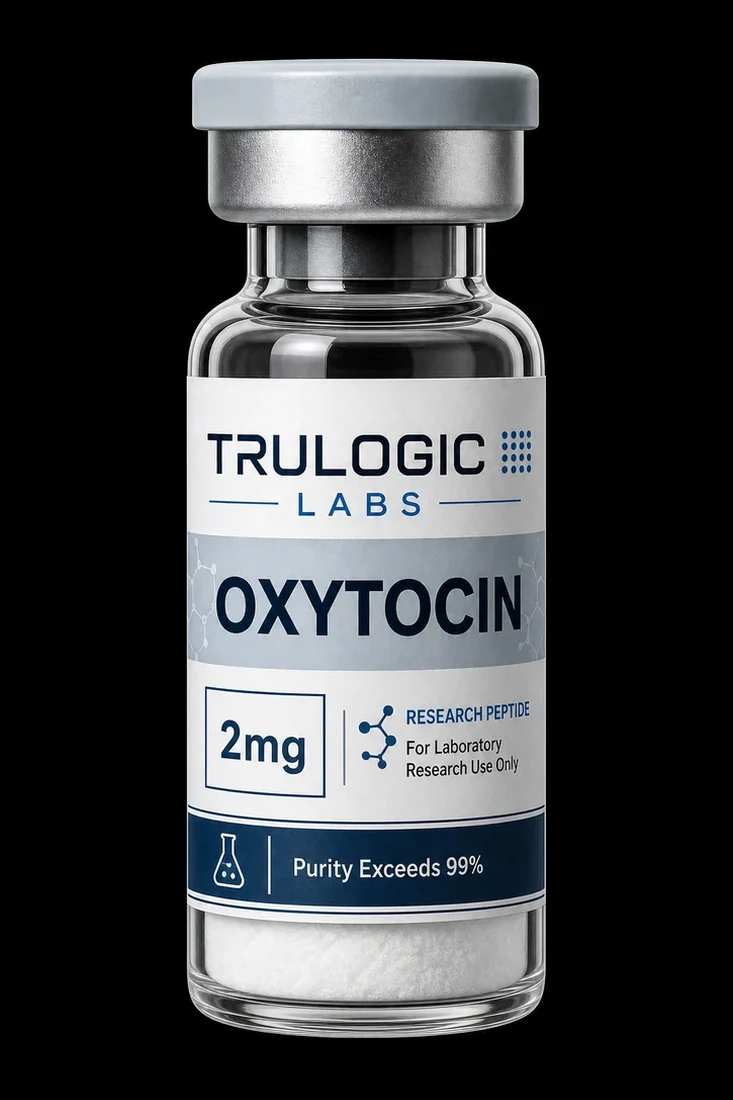
Oxytocin is a nine-amino-acid peptide hormone produced in the hypothalamus and secreted by the posterior pituitary gland. It has long-established physiological roles in uterine contraction during labor and milk ejection during lactation, and corresponding approved clinical applications in obstetrics. Beyond these functions, it has become a major focus of neuroscience research for its proposed roles in social cognition, affiliation, trust, and modulation of the stress response.
Mechanism of action
Oxytocin acts through the oxytocin receptor, a G-protein-coupled receptor expressed in peripheral tissues (such as uterine and mammary smooth muscle) and in numerous brain regions involved in social and emotional processing. Centrally, it functions as a neuromodulator that can influence amygdala activity and reward-related circuits in research models. Its peripheral and central actions are studied somewhat separately given limited blood-brain barrier penetration of circulating peptide.
Research findings
Oxytocin has well-established physiological roles in parturition and lactation, with approved obstetric uses.,Neuroscience research has examined associations with social bonding, trust, and affiliative behavior.,Studies have explored its modulation of stress and amygdala-related responses.,Research using intranasal formulations has investigated central effects, with mixed and context-dependent results.,Findings in social-cognition research are nuanced and not uniformly replicated.
Research context
Oxytocin has a very short plasma half-life on the order of minutes, and central nervous system research frequently employs intranasal formulations because circulating peptide poorly crosses the blood-brain barrier; the relationship between peripheral and central exposure is an active research question. Study endpoints range from physiological measures to behavioral and neuroimaging outcomes, with substantial variability across designs. This is a research reference only. Not approved for human use outside regulated settings; consult the primary literature.
Handling & storage
Lyophilized powder is generally stored frozen and protected from light and moisture under controlled laboratory conditions. Oxytocin in solution is sensitive to heat and degradation; reconstituted material is typically kept cold and used promptly per standard peptide laboratory handling, avoiding repeated freeze-thaw cycles.
Reported safety signals
In its established obstetric context oxytocin has a defined clinical safety profile managed by clinicians. In neuroscience research settings tolerability is generally reported as acceptable, though context-dependent effects on mood and social processing are noted; comprehensive characterization continues.
Studied alongside
In cognitive and mood research oxytocin is discussed alongside other neuroactive peptides such as Selank and Semax, and in the broader context of stress and sleep with compounds such as DSIP.
At a glance
Research strengths
- Well-characterized endogenous hormone with defined receptor biology
- Established physiological roles and approved obstetric applications
- Large, active neuroscience research literature
- Clearly defined sequence and physicochemical properties
Limitations & cautions
- Social-cognition findings are mixed and context-dependent
- Very short half-life and limited blood-brain barrier penetration complicate central study
- Peripheral vs. central effects are difficult to disentangle
- Research-context use is distinct from approved clinical use and unproven for general application