Overview
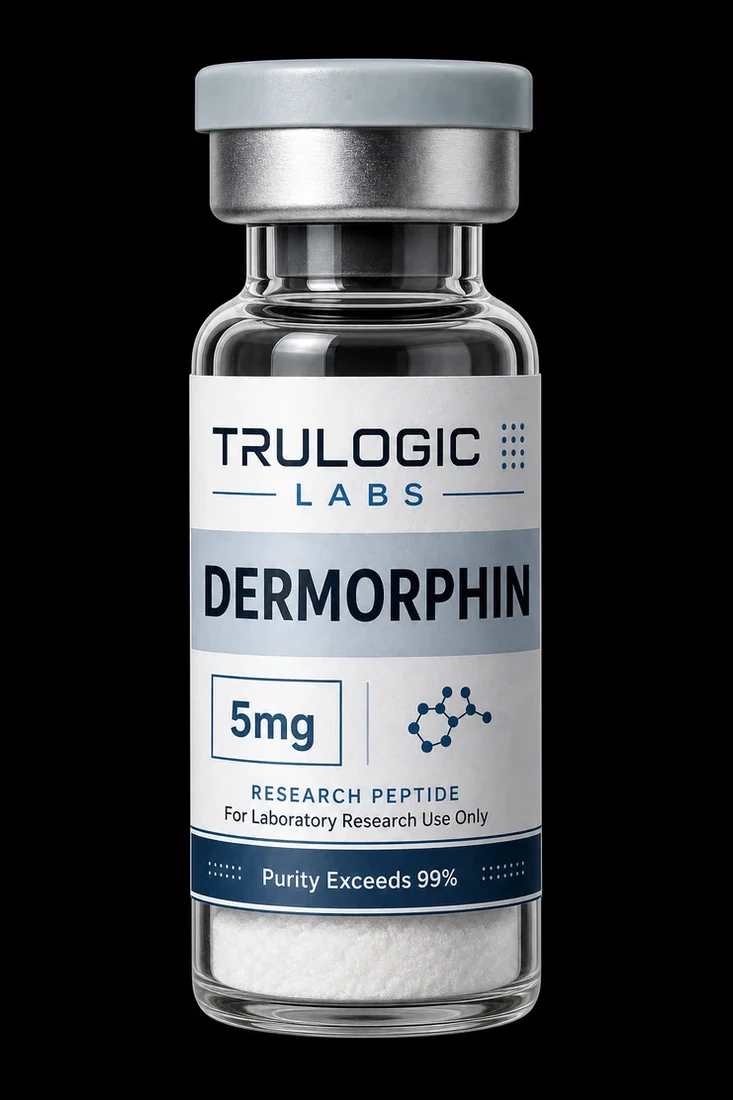
Dermorphin is a naturally occurring opioid heptapeptide first isolated from the skin secretions of Phyllomedusa frogs of South America. It is notable for containing a D-alanine residue, an uncommon feature in natural peptides that contributes to its stability and high receptor affinity. Dermorphin is studied primarily as a pharmacological tool in opioid receptor research and is not approved for therapeutic use. It is grouped here within the broader research-peptide library; its biology is centered on opioid signaling rather than tissue repair.
Mechanism of action
Dermorphin is a highly potent and selective agonist at the mu-opioid receptor, the same receptor class targeted by classical opioid analgesics. Activation of this G-protein-coupled receptor modulates pain signaling and related pathways. The D-alanine residue in its sequence increases resistance to enzymatic degradation relative to all-L-amino-acid peptides, which is a frequently cited feature in the research literature.
Research findings
Acts as a potent and selective mu-opioid receptor agonist in pharmacology studies.,Contains an unusual D-amino acid (D-alanine) that increases stability.,Used as a research tool to probe opioid receptor signaling.,Reported high potency relative to many classical opioid agonists in laboratory models.,Human pharmacological data are limited and largely confined to research contexts.
Research context
Dermorphin is studied as a research probe of opioid signaling. Its pharmacokinetic parameters in humans are not well characterized. Because it engages opioid receptors, it carries the general research considerations associated with potent opioid agonists, and reported experimental ranges should be interpreted strictly from the primary literature. This is a research reference only. Not approved for human use outside regulated settings; consult the primary literature.
Handling & storage
Lyophilized powder is typically stored frozen, protected from light and moisture, in a laboratory setting with appropriate controls. Reconstituted material is generally handled cold per laboratory protocol. As a potent opioid-receptor-active compound, it warrants careful institutional handling and access controls; follow applicable regulations and biosafety guidance.
Reported safety signals
As a potent mu-opioid agonist, the compound’s pharmacology is associated with the recognized risks of opioid receptor activation in research contexts. Human safety outside controlled research is not established.
Studied alongside
Dermorphin is studied as an isolated pharmacological tool rather than in combination; it is not typically discussed as part of tissue-repair peptide stacks.
At a glance
Research strengths
- Potent, selective mu-opioid receptor agonist useful as a research tool
- Enhanced stability from its D-alanine residue
- Well-defined natural sequence
- Valuable probe in opioid pharmacology research
Limitations & cautions
- Engages opioid receptors, carrying associated research risks
- Not approved for therapeutic use
- Human pharmacokinetics not well characterized
- Requires careful regulatory and handling controls