Overview
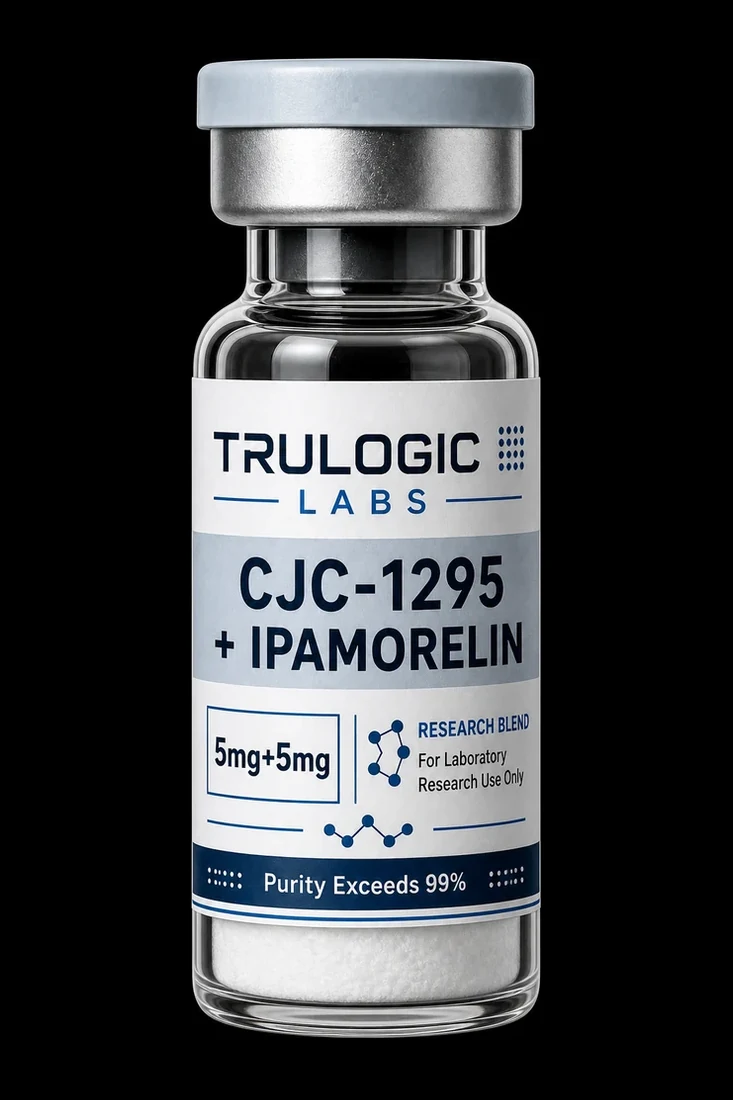
This is a two-component growth hormone secretagogue blend. CJC-1295 is a synthetic analog of growth-hormone-releasing hormone (GHRH), designed to stimulate the pituitary to release growth hormone; some versions include a drug affinity complex (DAC) that extends its duration. Ipamorelin is a selective growth hormone secretagogue that mimics ghrelin at the GHSR receptor and is noted for its selectivity.
The blend pairs the two because they act on different receptors within growth hormone regulation, and the combination is among the most discussed GH-secretagogue research pairings. Both remain research compounds without broad human therapeutic approval.
Mechanism of action
Research suggests CJC-1295 acts as a GHRH analog, binding GHRH receptors on pituitary somatotrope cells to stimulate growth hormone synthesis and release. Ipamorelin acts on the growth hormone secretagogue receptor (the ghrelin receptor), stimulating GH release through a separate pathway and amplifying GH pulses.
The rationale for combining them is that GHRH-pathway stimulation and ghrelin-pathway stimulation are complementary, so engaging both is studied as a way to produce a more pronounced effect on growth hormone release than either alone. Ipamorelin is noted in the literature for its relative selectivity, with limited effect on other hormones such as cortisol and prolactin.
Research findings
CJC-1295 has been studied as a GHRH analog that stimulates pituitary growth hormone release.,Ipamorelin has been studied as a selective ghrelin-receptor growth hormone secretagogue.,Research suggests the two act through complementary receptor pathways.,Ipamorelin is reported to have limited effect on cortisol and prolactin relative to some secretagogues.,DAC-containing CJC-1295 is reported to have a substantially extended duration of action.
Research context
Reported half-life differs markedly between the components, with DAC-containing CJC-1295 having a notably extended profile compared with ipamorelin, and study parameters are drawn from research settings rather than approved therapeutic use. Combined pharmacokinetics for the blend are not well characterized. This entry summarizes findings at a high level only. This is a research reference only. Not approved for human use outside regulated settings; consult the primary literature.
Handling & storage
Lyophilized peptide blend is typically stored at -20 degrees Celsius for long-term laboratory storage and protected from light and moisture. After reconstitution in a laboratory context it is generally refrigerated and used within a limited window. Avoid repeated freeze-thaw cycles.
Reported safety signals
As research compounds, neither component has a fully characterized human safety profile. Effects associated with growth hormone secretagogues in the literature relate to their hormonal activity. Neutral safety characterization should rely on the primary literature.
Studied alongside
This blend itself pairs two complementary secretagogues. In broader research discussion it is sometimes referenced alongside recovery peptides such as BPC-157 and TB-500, though those address different pathways and combined data are limited.
At a glance
Research strengths
- Engages two complementary growth hormone pathways.
- Ipamorelin is noted for receptor selectivity.
- Among the most-studied GH-secretagogue research pairings.
- Optional DAC versions of CJC-1295 extend duration.
Limitations & cautions
- Neither component is approved for general human therapeutic use.
- Component half-lives differ widely, complicating characterization.
- Human clinical efficacy data are limited.
- Blend pharmacokinetics are not well characterized.