Overview
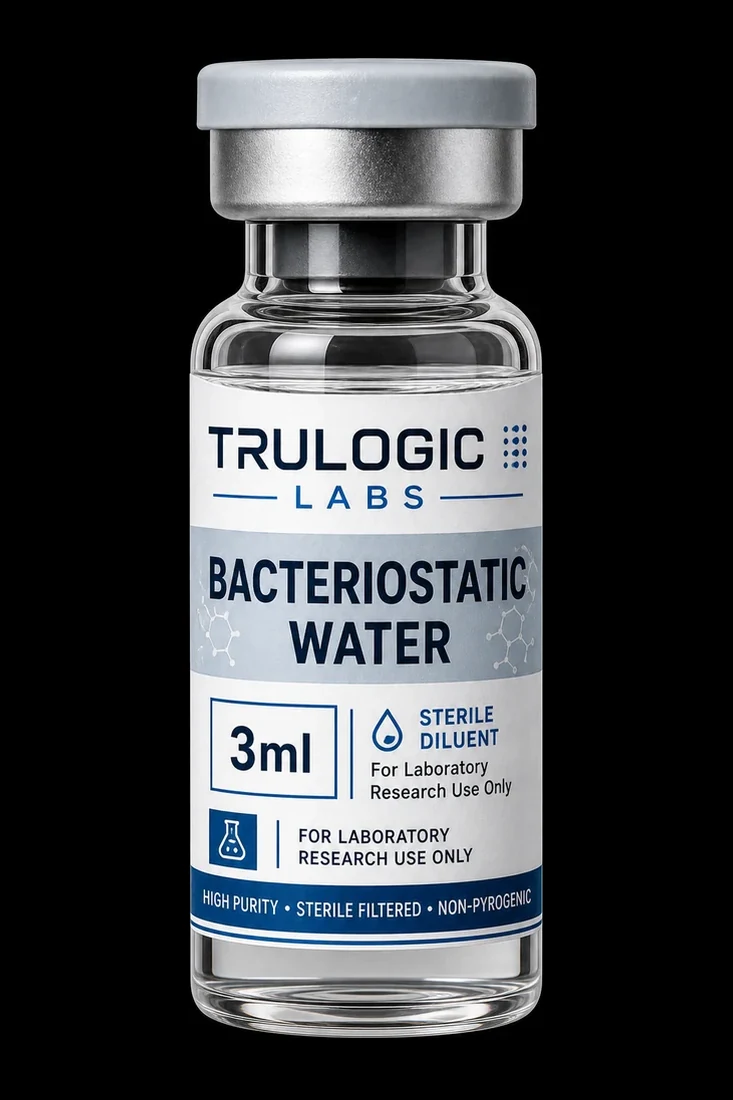
Bacteriostatic water is sterile water for injection that contains 0.9 percent benzyl alcohol as a preservative. The benzyl alcohol is bacteriostatic, meaning it inhibits the growth of bacteria, which is what distinguishes it from plain sterile water and allows a container to be accessed more than once in laboratory work.
It is included in this reference as a laboratory accessory and diluent rather than as a research compound. Its purpose is to serve as a solvent for reconstituting lyophilized peptides and other materials in a research setting.
Mechanism of action
The active distinguishing ingredient is benzyl alcohol, which acts as a bacteriostatic preservative by inhibiting the growth and reproduction of bacteria in the solution. The water itself functions as the solvent.
Unlike the peptides and hormones in this reference, bacteriostatic water has no pharmacological target of its own. Its role is purely as a diluent and preservative-containing carrier.
Research findings
Functions as a general-purpose sterile diluent in laboratory settings.,Contains 0.9% benzyl alcohol as a bacteriostatic preservative.,Allows multiple withdrawals from a container due to its preservative.,Has no pharmacological activity of its own.,Distinct from preservative-free sterile water for single-use applications.
Research context
Bacteriostatic water is a solvent and laboratory accessory, not a research compound, so concepts such as half-life, dosing, and pharmacokinetics do not apply to it. Its relevance is purely as a diluent for reconstituting other materials. This is a research reference only. Not approved for human use outside regulated settings; consult the primary literature.
Handling & storage
Stored at controlled room temperature in laboratory settings and protected from contamination. Containers are kept sealed until use and handled aseptically. As a preservative-containing solution it is intended to tolerate multiple withdrawals within established laboratory practice.
Reported safety signals
As a diluent, considerations relate to its benzyl alcohol content, which is not suitable for all applications. It has no active pharmacology of its own. Safety characterization should rely on the primary literature.
Studied alongside
Not applicable as an active compound. As a diluent it is used across the laboratory handling of essentially all the lyophilized peptides in this reference, including the recovery and repair blends.
At a glance
Research strengths
- General-purpose sterile diluent for laboratory work.
- Preservative allows multiple withdrawals.
- Widely available and well understood.
- No pharmacological activity to complicate handling.
Limitations & cautions
- Benzyl alcohol content is unsuitable for some applications.
- Not a research compound, only a carrier.
- Must be handled aseptically to retain sterility.
- Distinct from preservative-free water required in certain uses.